Killi
   
curve
Nannostomus - Pencilfish
Nannostomus (Pencilfish)

Alan Vassiere passed away in 2012 as a the leading authority on breeding Pencilfish. Here are his notes on breeding these fish.

"I have long been a fan of this particular family of Characins. I have at the moment 8 species; - N.nitidus, N.beckfordi, N.marginatus, N.eques, N.espei, N.mortenthaleri, N.unifasciatus and what I think could be Nannostomus marilynae. The classification of the pencil fish is a little confusing as you will see them listed under Poecilobrycon, Nannobrycon and Nannostomus. However, of late, the guys who sort this out seem to have settled for them all to be Nannostomus which I prefer to call them. This though, is where the similarities end.

I have to date spawned 6 species; - N. nitidus, N. beckfordi, N. marginatus, N. mortenthaleri, N. espei and eques and believe me they all differ in their breeding habits. I must point out here, that these are my own observations and in no way do I advocate that this is the only way to succeed with them.

Egg scatterers
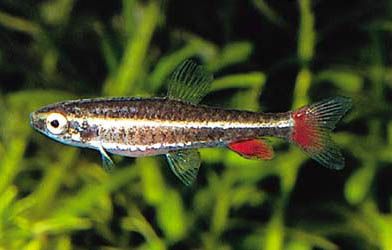
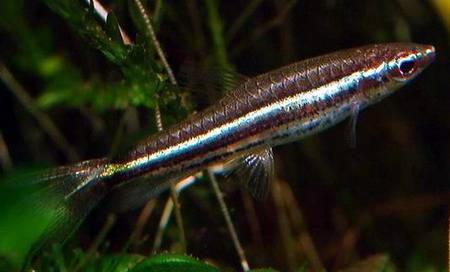
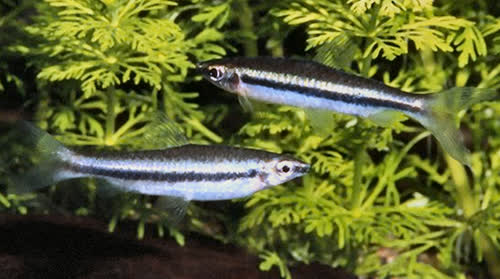
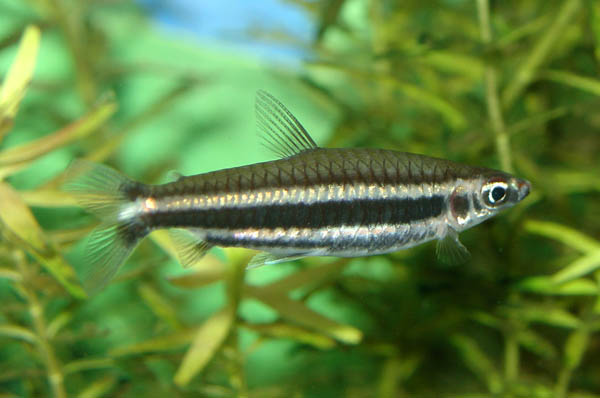
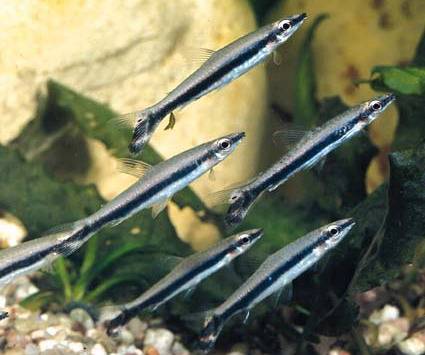
Nannostomus beckfordi is of course the easiest of them all to spawn along with N. nitidus. They can be set up over a grill and will usually spawn the next morning. Water quality needs to be good but is not as critical as with some of the others. Nannostomus nitidus is perhaps not quite as readily spawned but if in good condition should not present too many problems.

Leaf spawners
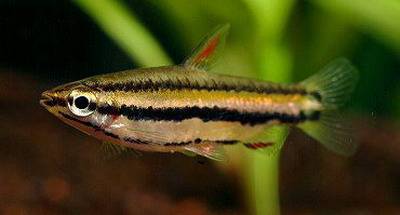
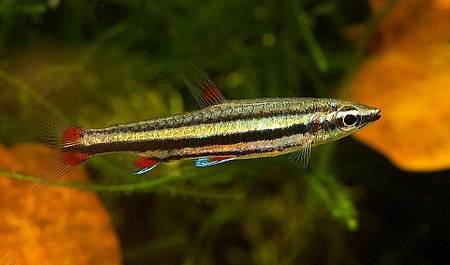
The next two, although both spawn under plant leaf are still quite different. Eques as you will know, swim at an angle with head up, while N. espei is at the normal straight posture, so you might not think that they both lay under a plant leaf but they do, and always do. I have spawned them both a number of times and it has always been the same, contrary to what I have read in some breeding reports. They can both be set up the same way, in a small tank with artificial plants, while the water needs to be quite soft and good quality. The temperature of my breeding tanks tends to be towards 80F. For Nannostomus espei, the pH needs to be lower, down to around 5 to 5.5. However, this again is where the similarities end." - AV.


Nannostomus beckfordi is of course the easiest of them all to spawn along with N. nitidus. They can be set up over a grill and will usually spawn the next morning. Water quality needs to be good but is not as critical as with some of the others. - AV


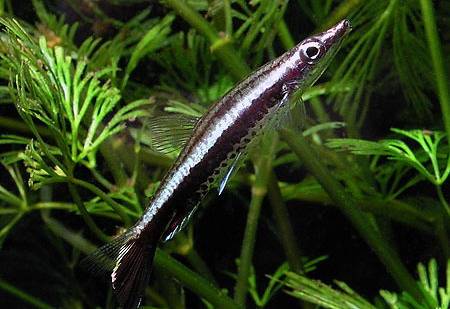
Nannostomus eques will spawn quite readily and with any partner and will spawn in one go. Plants can be removed to a smaller hatching tank and another pair put into the spawning tank. I myself prefer to set up two or three tanks and remove all plants to the same hatching tank; - this can give a better yield as losses can sometimes be high with this species. - AV


espeii
breeding

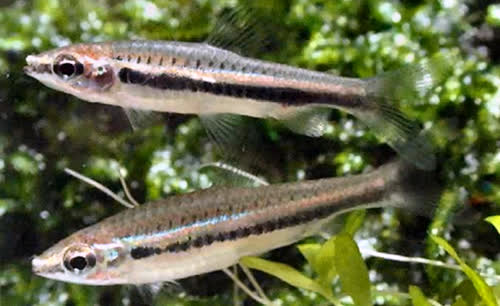
Nannostomus espei can be quite a problem in as much as they are by far the most selective fish I have ever come across. I have in the past had a pair that would spawn quite readily, then one died and the remaining one tried with up to 10 new partners without success. I have at the moment 20 fish and after a lot of rotation have just managed to find a pair to spawn. If, however you are lucky enough to get a pair to spawn make sure you keep them away from the rest. Once you have a pair they are then not that difficult and will in fact spawn quite readily. Also, something worth noting with this species, is that they spend much longer under the plant leaf than any other species that spawn like this, I have timed them up to 2 minutes.

This last species proves a point which I repeatedly try to get across to potential breeders, that selection is probably the most important but least thought about aspect of fish breeding. I have been breeding fish for more years than I care to remember and believe me there are more species, out there than you think, that are selective. This also is the reason you will hear people say when discussing breeding, “Oh I have bred them they are easy”. This usually means they have just got lucky and would have a job to repeatedly breed the more difficult species. If there is a secret to fish breeding this is it. Update on plant spawners (Oct ‘08) Some further observations on pencil fish, namely Espei. I have bred these on a number of occasions, but I only ever spawned them in the spawning tank, removing the fish after spawning had taken place.

However over the years I have refined my procedure with the species that spawn on plant leaves. I fine tuned the technique with Harlequins where I needed large numbers, so rather than removing the fish after spawning, I now remove the plant. This has proved to be very successful, in that all the eggs can be hatched together, so freeing up the spawning tanks. I have now extended this procedure to the pencil fish.

To get back to the purpose of this update. On the latest spawning of Espei they spawned as usual and I removed the plant to a small hatching tank, only this time I dropped another plant in to see what happened. They did in fact spawn again after two days, then again after another two days, and again after a further four days. They did not lay many eggs on these occasions but then it is more than I would have had if I just removed the fish. As a matter of interest this attempt has produced 83 fry where I would have perhaps expected 30 to 40.

I was aware that Mortenthaleri and Marginatus were what I would call continuous spawners, but I would not consider Espei as such. However, it was an interesting experience, and I will consider this next time. Also, I will try the same with Eques. " - AV


"Males of N. rubrocaudatus can be told apart from those of N. mortenthaleri by the fact that the red pigmentation in the rear half of the body is purplish and more uniform than in N. mortenthaleri which when not breeding only displays red colouration between the primary and secondary lateral stripes."

Alan P. Vaissiere

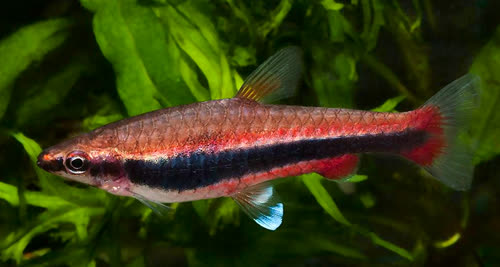
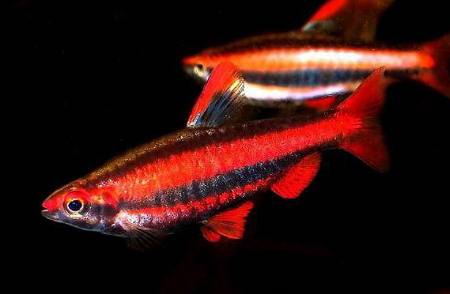
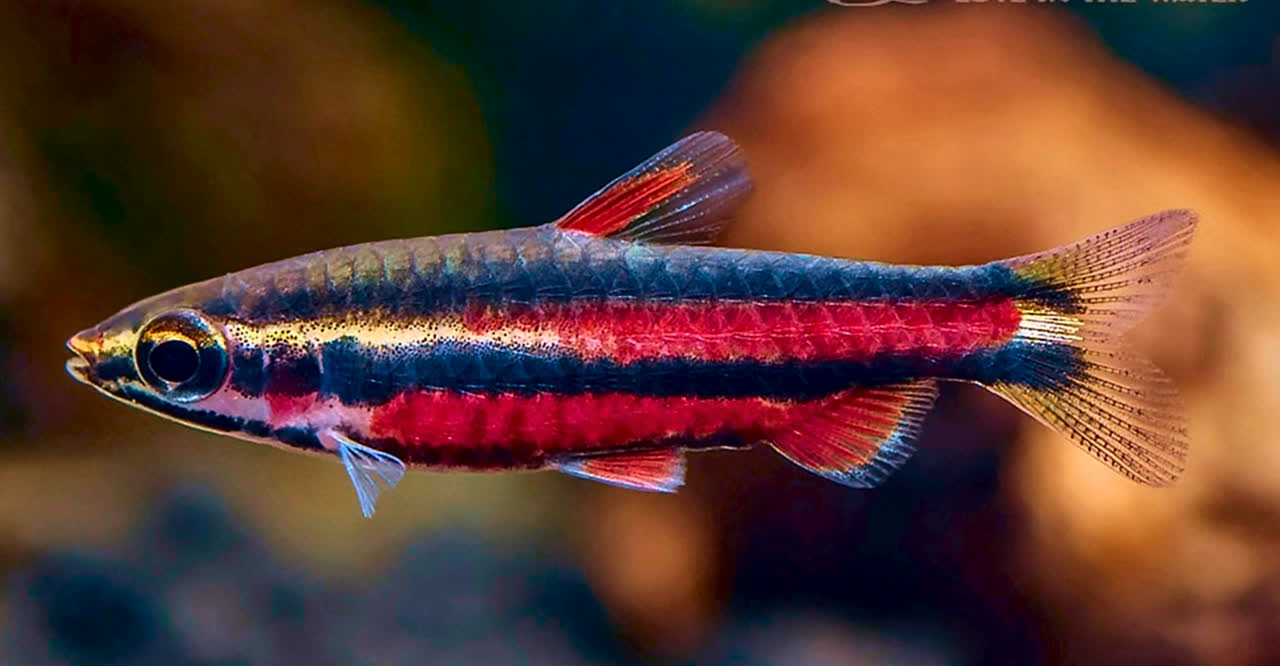
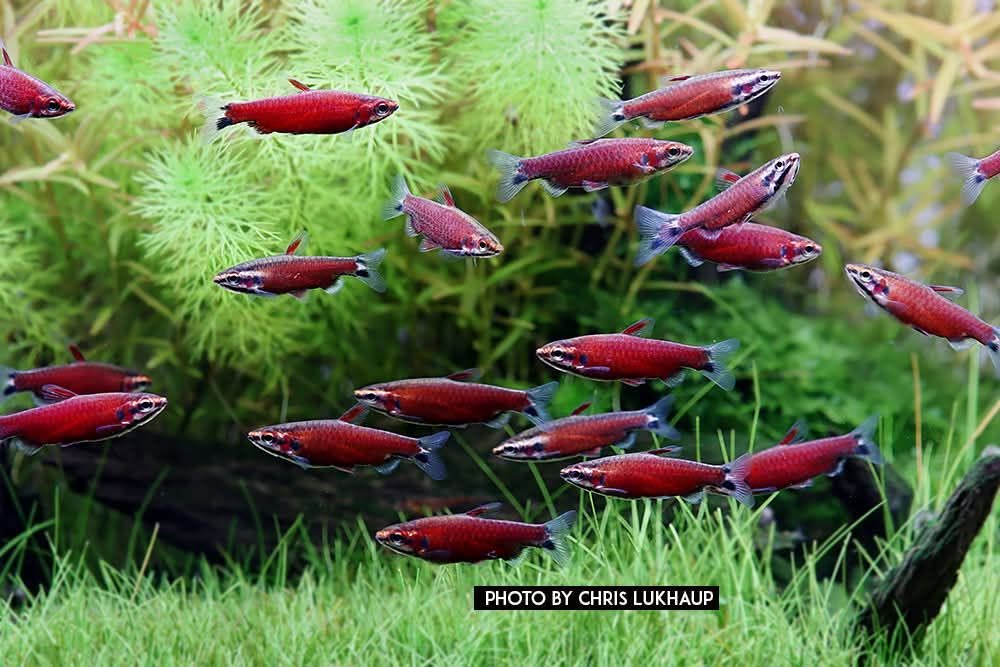
"Last but most certainly not least is Nannostomus mortenthaleri, the brilliant Coral Pencil. This has only been discovered in the last few years and caused quite a stir when it first appeared. As per normal for a newly discovered species, it also was a silly price! To make matters worse it was difficult to keep alive and most who bought it, myself included, paid silly money and struggled to simply keep them alive They were found in a remote part of the Peruvian forests and were difficult to transport to holding stations. This however has now improved and you have a much better chance of obtaining them at a more realistic price and a much better chance of keeping them alive. With what little information was available, my first attempts were not too successful but I did get one or two fry. My attempts were similar to Marginatus and as I said not too successful.

Last year I was privileged to meet Hans-Georg Evers, the editor of the excellent German magazine “Amazonas”. He is also a brilliant fish breeder and we discussed many aspects of fish breeding when he interviewed me for Amazonas. This believe me was quite an honour. We discussed N.mortenthaleri in some detail and the information was duly filed away in the corner of my brain. Early this year another good friend Mark Breeze gave me 5 corals. I had two left of my last lot, so after a couple of weeks I decided that perhaps now was the time to try again. With the information I had gained from Hans, I set up a permanent home for them. Hans had told me that they were quite territorial, (this I had already learned), so plenty of cover was provided. This attempt did produce12 fry but I learned a great deal from it. My next attempt was a little more thought out. This time I only used two pairs and the tank was set so that the males could control an end each, which was in fact what they did. I had used r/o water and Almond leaves, so the water was very dark with just a small area in the centre that was clear, so they could set their boundaries. I observed them quite closely over the next couple of weeks and knew they were spawning. There was no aggression and the males would swim around the female to try to get her into the mops and on occasions succeeded. When I thought the time was right I removed the fish and this attempt produced 45 fry.

I don’t know if they are being bred in this country, but I know they are being done in Europe, but believe numbers are low. I will now experiment to see if I can improve on this but for now I am going to count this as a success. The sexing of Mortenthaleri can be a bit of a problem. The males are much deeper in body and colour which is not much help and most of what I had read didn’t seem to help either! Mark Breeze said his European friend who was breeding them sexed them by the dorsal; - this is taller and the lower part of the front ray is white. This has proved to be right and I am now confident with this.

Just as a mater of interest as I said last time, I would experiment with the Mortenthaleri. I did refine my procedure and am at the moment in the middle of another attempt which is proving more successful. I currently have 63 fry with, I think, more to come. I hope my observations help other aquarists in their breeding attempts. Some of these methods can be used with other species. " - AV


Nannostomus nitidus is perhaps not quite as readily spawned but if in good condition should not present too many problems. - AV


Prior to description this species was traded as Nannostomus sp. ‘purple’, N. cf. marginatus ‘red pencil II’, or N. sp. ‘coral red II’.

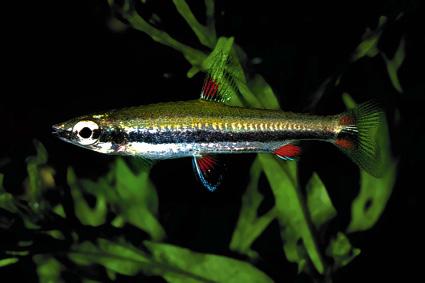
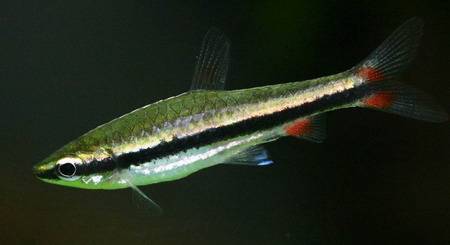
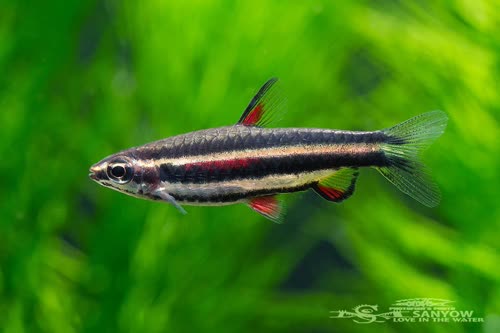
It can be told apart from similar species by the following combination of characters, adapted from Zarske (2009): pronounced sexual dimorphism with adult males exhibiting bright red-purple pigmentation between the central, upper, and lower (primary, secondary and tertiary) dark lateral stripes; all three dark lateral stripes strong and distinctive; central (primary) lateral stripe in males extending ventrally to posterior half of anal-fin base; anterior part of dorsal-fin in males red; adipose-fin absent; males with modified, thickened anal-fin rays; 2 teeth on each maxillary bone.

In live fish colour pattern is perhaps the most useful way to identify N. rubrocaudatus plus the closely-related N. marginatus and N. mortenthaleri.

N. marginatus is immediately distinguished from the other two by the fact it lacks red pigmentation on the body in males, but N. mortenthaleri and N. rubrocaudatus are more easily-confused.

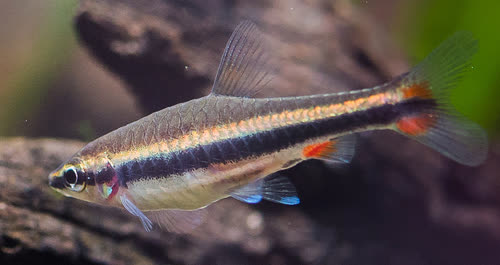
Males of N. rubrocaudatus can be told apart from those of N. mortenthaleri by the fact that the red pigmentation in the rear half of the body is purplish and more uniform than in N. mortenthaleri which when not breeding only displays red colouration between the primary and secondary lateral stripes.

In N. rubrocaudatus the anterior portion of the dorsal-fin is red and the distal portion hyaline, and the ventral fins are reddish proximally, hyaline distally, while in N. mortenthaleri there is a white blotch at the anterior base of the dorsal-fin and the distal part of the fin is red, and the ventral and anal fins are more-or-less entirely red.

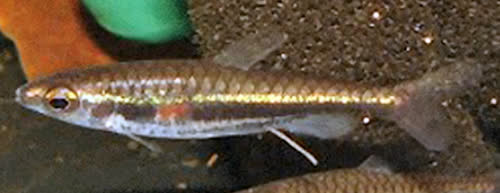
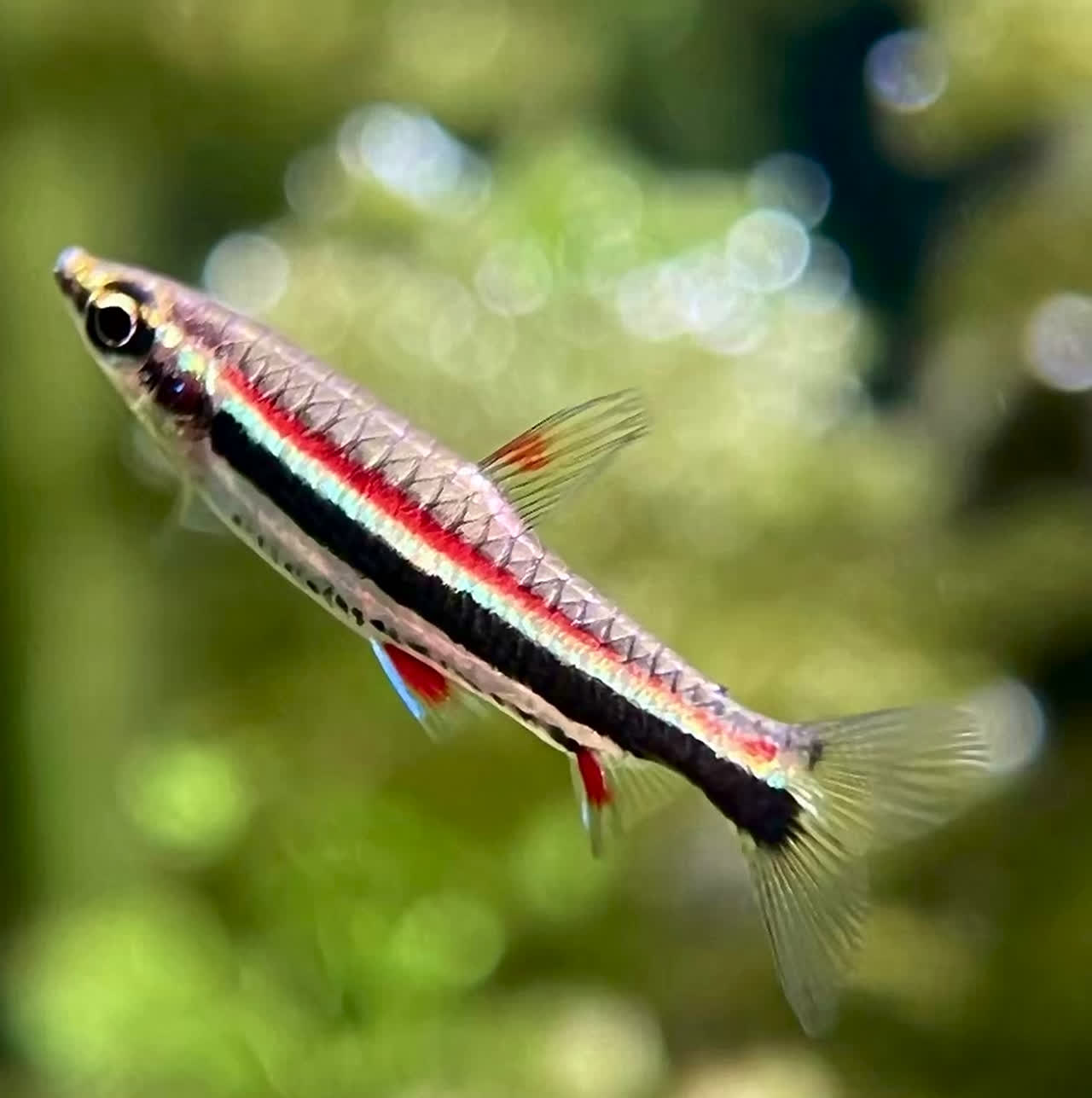
In females of N. rubrocaudatus the interspace between primary and secondary lateral stripes is silvery with a reddish stripe below the primary dark stripe in the rear of the body and a small red patch between the primary and tertiary stripes anterior to the anal-fin, while in N. mortenthaleri the entire area between primary and secondary stripes is reddish.

As in males the ventral and anal fins are reddish proximally and hyaline distally in N. rubrocaudatus, more-or-less uniformly reddish in N. mortenthaleri.

Don’t worry if your fish look different when you switch on the aquarium lights after dark or in the morning as like most Nannostomus species it assumes a different colour pattern at night, in this case the entire colour pattern paling considerably and the dark lateral stripes disappearing.

This diurnal rhythm has been show to occur in blind specimens, suggesting it’s an automatic response that the fish cannot control.

Alan P. Vaissiere


 encycloquaria.com